



Modern advertising platforms like Google Ads and Meta Ads are incredibly powerful. Their machine learning algorithms can analyse millions of signals in real time to identify the users most likely to convert.
But there’s a catch.
These platforms are only as intelligent as the data they receive. Most marketing teams believe their ad campaigns are optimised for conversions - but in many cases, they’re not.
Most marketers spend a lot of time trying to improve their campaigns by testing new creatives, play around on targeting, multiple experiments (A/B Testing) with landing pages and headlines. But there’s a quieter issue hiding underneath many ad accounts — and it has nothing to do with creative strategy or media buying skills.
Most ad platforms simply don’t know who actually became your customer. They know who filled a form, who clicked on website/button, and who started conversation. But the moment a lead moves into a sales call, a WhatsApp conversation, or a CRM pipeline, the trail often disappears. From that point onward, the algorithm is guessing.
It continues optimising campaigns based on the signals it can see — even if those signals have very little connection to real revenue. The result is something many marketers experience but struggle to explain: campaigns generate plenty of activity, yet business outcomes don’t improve at the same rate. What’s missing isn’t better targeting or better creatives.
It’s better signals.
And once you start sending those signals back to your ad platforms, the way your campaigns learn and improve begins to change. Once you start noticing this gap, you realise it quietly affects almost every performance marketing setup today.
The signals problem most marketers overlook
Platforms like Meta and Google rely heavily on signals to understand which users are valuable. Every time someone clicks an ad, fills a form, or starts a conversation, that action becomes feedback for the algorithm. Over time the platform learns patterns. It begins to identify users who are more likely to perform that action again.
This is the foundation of performance advertising. But the system only works properly when the signals represent real outcomes.
If a campaign is optimised for lead submissions, the platform will find more people who are likely to submit forms.
That sounds logical, but anyone who has run lead generation campaigns knows the truth: not all leads are equal. Some leads convert into paying customers. Many never respond to a sales call. Yet from the platform’s perspective, both look identical. So the algorithm keeps chasing the same behaviour—more leads—without understanding which ones actually generate revenue. Over time, the gap between marketing metrics and business results becomes wider.
The invisible part of the customer journey
In many industries, the real conversion does not happen on the website. Take a typical high-ticket customer journey: -
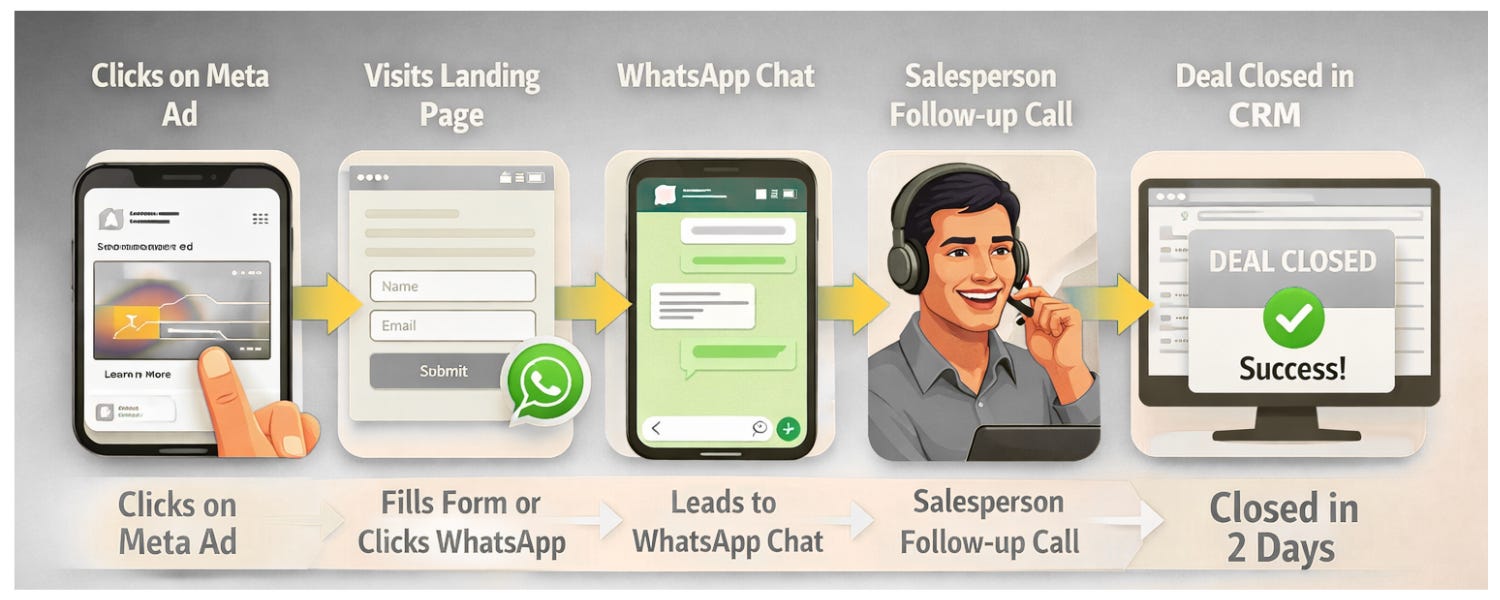
A user clicks an ad, visits the website, starts a WhatsApp conversation, speaks with a salesperson, and the deal is finally closed in the CRM a few days later. From the ad platform’s perspective, the journey ends at “conversation started” or “Leads”.
Everything that happens afterward—conversations, negotiations, confirmations—remains invisible. This is what many marketers now refer to as “the dark funnel.” Not because it’s mysterious, but because it sits outside the visibility of advertising platforms. And it’s far more common than most people realise.
The dark funnel.
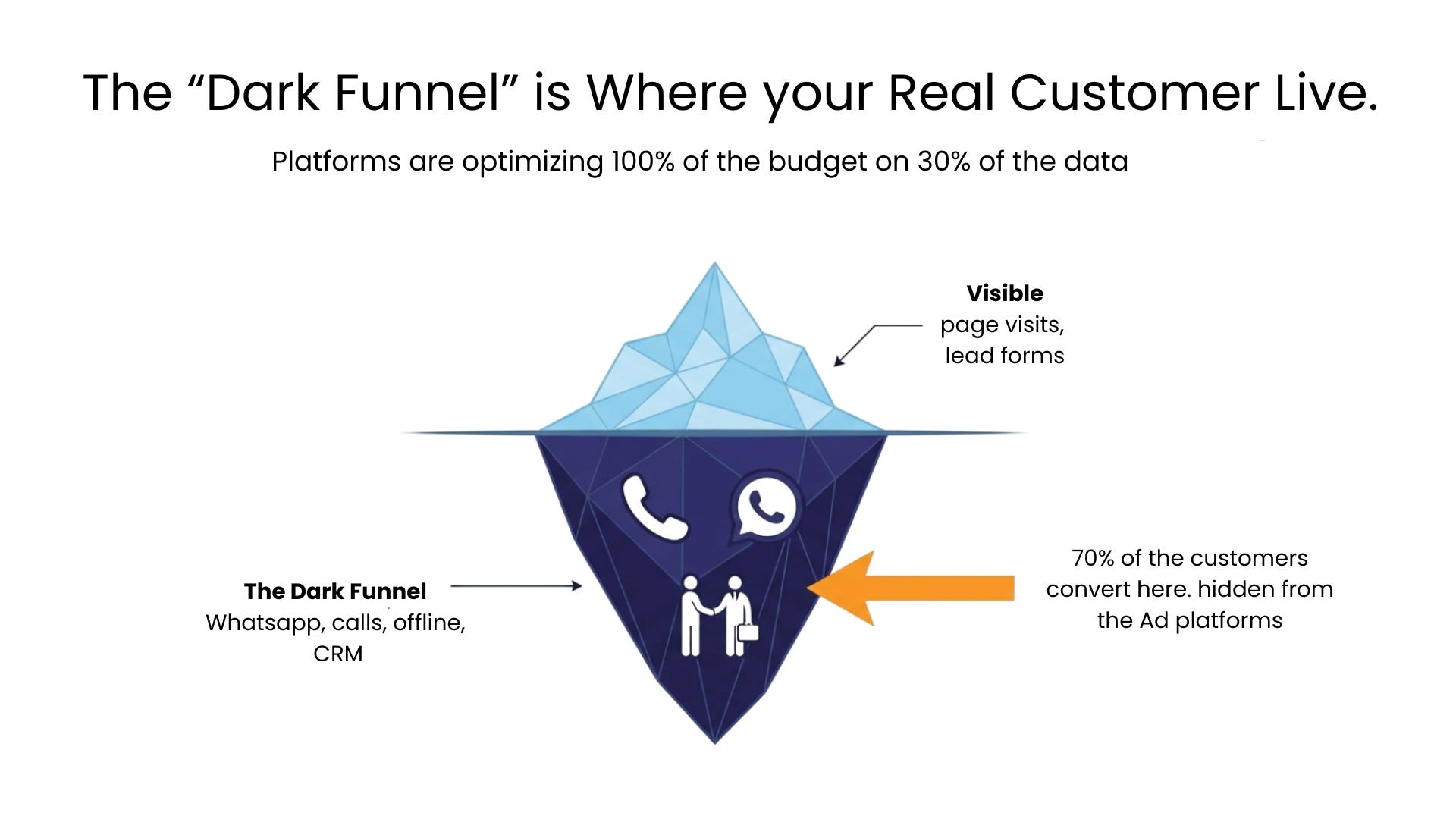
In many industries, the real conversion happens well after the first interaction. Education companies often convert students after counselling calls, real estate purchases happen after site visits and follow-ups, healthcare inquiries turn into treatments days later, and B2B deals usually close only after multiple discussions. In all these cases, ad platforms only see the very beginning of the journey. Trying to optimise campaigns with that limited view is like making decisions after reading only the first chapter of a book.
Why this quietly increases acquisition costs
When platforms lack visibility into final conversions, they default to the easiest available signal. - Usually, that’s a lead.
And algorithms are extremely good at finding cheap leads. The problem is that cheap leads are often the least valuable ones. They might be people casually browsing. They might submit forms out of curiosity. Some might not even remember filling out the form when your sales team calls them. But the algorithm doesn’t know that. All it sees is a successful conversion event. So it keeps finding more of those users.
This is one of the reasons many businesses experience a strange pattern: campaign metrics look healthy, but revenue doesn’t grow at the same pace. It’s not necessarily a creative problem or a targeting issue.
Often, it’s simply a signal problem.
What changes when platforms see real conversions
When businesses start sending actual conversion outcomes back to ad platforms, something interesting happens. The algorithm begins to recalibrate.
Instead of learning from every lead, it starts identifying the characteristics of users who eventually become customers. Gradually, campaigns begin shifting toward audiences that resemble those customers. This changes how the system allocates budgets, how it prioritises impressions, and even which placements it favours.
Over time, a few noticeable effects appear. Lead quality improves. Customer acquisition costs become more predictable. Campaign performance becomes easier to scale.
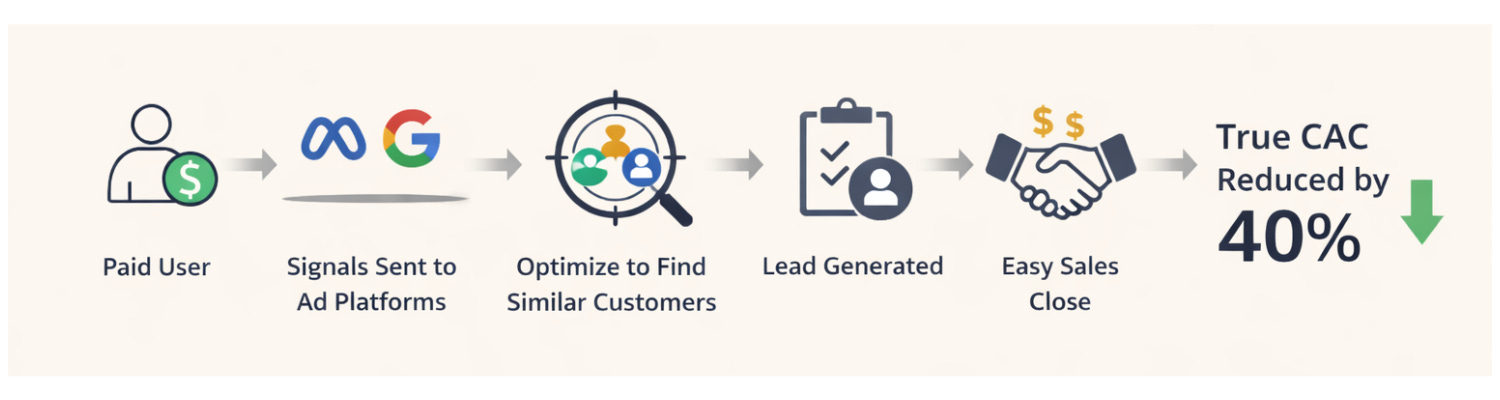
None of this happens overnight. But the algorithm finally receives the feedback it needs to understand what success actually looks like.
In simple terms, you stop training your ads to find form submissions and start training them to find customers.
Consider a company running ads for a professional certification program. The campaign generates around 1,000 leads, from websites or lead forms or WhatsApp conversations, which looks successful in the ad dashboard. But CRM data reveals that only a few hundred are qualified and just 30–40 actually enroll. If the ad platform only sees the leads, it treats all 1,000 as equal. But when enrollment data is sent back as the conversion signal, the algorithm starts optimising for the users who actually enroll—leading to better targeting and more efficient campaigns over time.
Why most marketers still don’t do this
Despite the benefits, many marketing teams still struggle to close this data loop. The main reason is simple: customer data is scattered across too many systems. Leads might enter through a website form. Conversations move to WhatsApp. Sales teams track progress inside a CRM. Final payments are recorded somewhere else entirely.
Connecting these systems in a reliable way isn’t always straightforward. It requires capturing identifiers, linking user journeys across platforms, and sending structured events back to advertising systems. For many businesses, the technical effort feels disproportionate to the perceived benefit. So the problem remains unsolved. Campaigns continue optimising for the earliest available signal.
Why this matters more now than before
The marketing ecosystem is changing quickly. Privacy regulations are tightening. Browser tracking is becoming less reliable. Third-party cookies are disappearing. In response, advertising platforms are increasingly relying on first-party signals—data provided directly by businesses. This means the quality of signals you send back to platforms will matter more than ever. The companies that build strong signal pipelines will have a clear advantage. Their campaigns will learn faster, optimise better, and scale more efficiently. Others will still be running campaigns—but their algorithms will be learning from incomplete data.
The quiet shift happening in performance marketing
For a long time, performance marketing was mostly about tracking what happened on the website—clicks, form submissions, and a few on-page conversions. That approach worked when most customer journeys were simple. Today, they rarely are.
Customers move across multiple touch-points before making a decision. An ad click might lead to a website visit, which turns into a WhatsApp conversation, a sales call, and eventually a purchase recorded in a CRM. The real opportunity now lies in connecting that entire journey and sending those outcomes back to the platforms running your campaigns.
It may not be the most exciting part of marketing, but it’s becoming one of the most important. When ad platforms can finally see who actually became a customer, the system starts working the way it was meant to. Targeting improves, budgets are used more wisely, and growth becomes far more predictable.
Because in modern performance marketing, the advantage doesn’t always come from spending more—it often comes from helping your algorithms understand what success actually looks like.
This is the problem Aixel is built to address. By connecting data across ads, CRMs, WhatsApp conversations, and other touch-points, Aixel helps businesses capture what happens after the click and send those real conversion signals back to their ad platforms.
While features like Enhanced Conversions for Leads and Offline Conversion Imports help send some conversion data back to ad platforms, platforms like Aixel aim to solve the larger problem—connecting fragmented touch-points like ads, CRM, and conversations into a single signal layer so ad algorithms can learn from the full customer journey.